
Skip to content
The lingwist

The lingwist

The Lingwist is the home for everyone who is passionate about language and linguistics. Feel free to share, discuss, and comment. The Lingwist's motto is " Learn & have fun"

  • Home
  • Discourse Analysis
  • Business Communication
  • English
    • Applied Linguistics
    • Core Linguistics
    • Grammar
    • Vocabulary
    • Functions
  • Composition
  • Privacy Policy!
  • About us
  • Contact Us!
  • Toggle search form

Composition 2

Posted on October 22, 2013December 9, 2022 By The Lingwist

Dear students,

Thank you for reading this post, don't forget to subscribe!
  • You are kindly asked to fitch the Handout from the Alanwar Copy center.
  • I will share here the theoretical part of the expository and argumentative essays (The practical part in the handout)
  • Your comments, remarks, and questions should be shared in the comment section

1. Expository Writing

1.1. What is Expository Writing?

 Expository writing is writing to explain. Expository writing seeks to inform, explain, clarify, define or instruct.

bcdc46439c3ab468b662c9c64a5da164

How is Expository Writing different from other types of writing?

•Expository writing does not tell a story.

•Expository writing does not persuade a reader but only gives facts and reasons.

•Expository writing is not a summary of the book. 

•Expository writing is not a book review or a book report.

•Expository writing is not ONLY your opinion.  You must base your ideas on evidence from the text.

Characteristics of Expository Writing

  • Focus on main topic
  • Logical supporting facts
  • Details, explanations, and examples
  • Strong organization
  • Clarity
  • Unity and coherence
  • Logical order
  • Smooth transitions

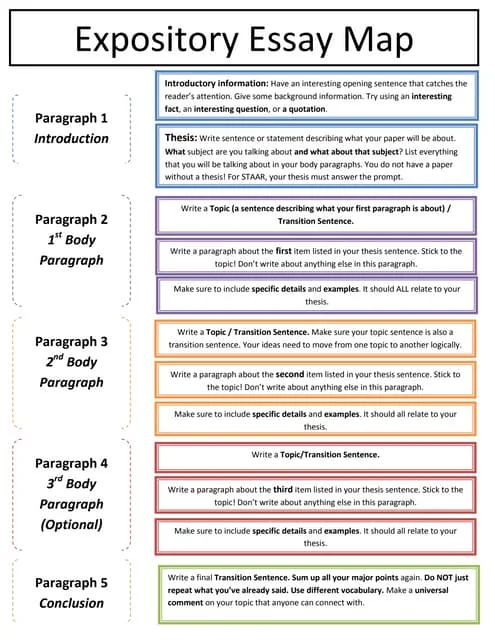
The Expository Essay Format
expositoryessaymap 131205103130 phpapp01 thumbnail.jpg

2. Argumentative Essay

Functions

Post navigation

Previous Post: Introductions and Socializing in Business Communication
Next Post: Speaking on the phone in Business communication

Categories

  • Applied Linguistics
  • Business Communication
  • Composition
  • Core Linguistics
  • Discourse Analysis
  • English
  • Functions
  • Grammar
  • Vocabulary
  • Brain and nonverbal
    How does the brain process and interpret nonverbal cues, such as facial expressions and gestures, in communication and language understanding? Applied Linguistics
  • Homogrpahs 2
    20 Hard but Useful Homographs you Should Add to your Vocabulary Immediately with Examples Applied Linguistics
  • Female Reading 1200x628 facebook
    Best Books to read in English Applied Linguistics
  • istockphoto 1254994312 170667a e1637102253133
    4 Golden Steps to Easily Learn Any Language Through Music Applied Linguistics
  • hhh
    The New Global Means of Communication: Will Emoji become the language of the future? English
  • istockphoto 1334281938 170667a
    Irregular Verbs Grammar
  • Foreign emotion words with no English equivalent
    10 Foreign emotion words with no English equivalent English
  • noname 2
    How do babies filter noise from language? English

Copyright © 2026 The lingwist.

Powered by PressBook News WordPress theme