Tautology is one of those interesting linguistic phenomena that you’ve probably encountered many times without even realizing it. While the word may sound complex, its definition is quite simple: tautology occurs when the same idea is repeated in different words, leading to redundancy. You might think of phrases like “free gift” or “ATM machine.” These are common examples of tautologies in everyday language.
Thank you for reading this post, don't forget to subscribe!But why is tautology important, and how does it affect our communication? In this article, we’ll explore its definition, dive into several examples, and discuss why understanding tautology is crucial for clear and effective communication. Let’s also sprinkle in some fun, because wordplay, even redundant wordplay, can be amusing!
1. What is Tautology?
At its core, tautology refers to the unnecessary repetition of ideas. In language, it’s when you say the same thing twice but in slightly different ways. The word comes from the Greek word tauto, meaning “the same,” and logos, meaning “word or idea.” When combined, you get a word that means “saying the same thing.”
An easy example of tautology is “It’s déjà vu all over again.” Here, “déjà vu” means something already seen, and “all over again” adds unnecessary repetition.
2. Types of Tautology
There are two primary types of tautology:
A. Logical Tautology
This type of tautology is more philosophical and relates to statements that are true in every possible interpretation. A simple example of a logical tautology would be, “Either it will rain tomorrow, or it won’t.” This statement is redundant because one of the two options must be true.
B. Rhetorical Tautology
Rhetorical tautology occurs in everyday speech or writing when a word or phrase is unnecessarily repeated. Think of phrases like “unexpected surprise” or “end result.” The repetition of the idea doesn’t add any new meaning, making the sentence longer without purpose.
3. Common Examples of Tautology in Language
Here are a few amusing and common examples of tautology in the English language:
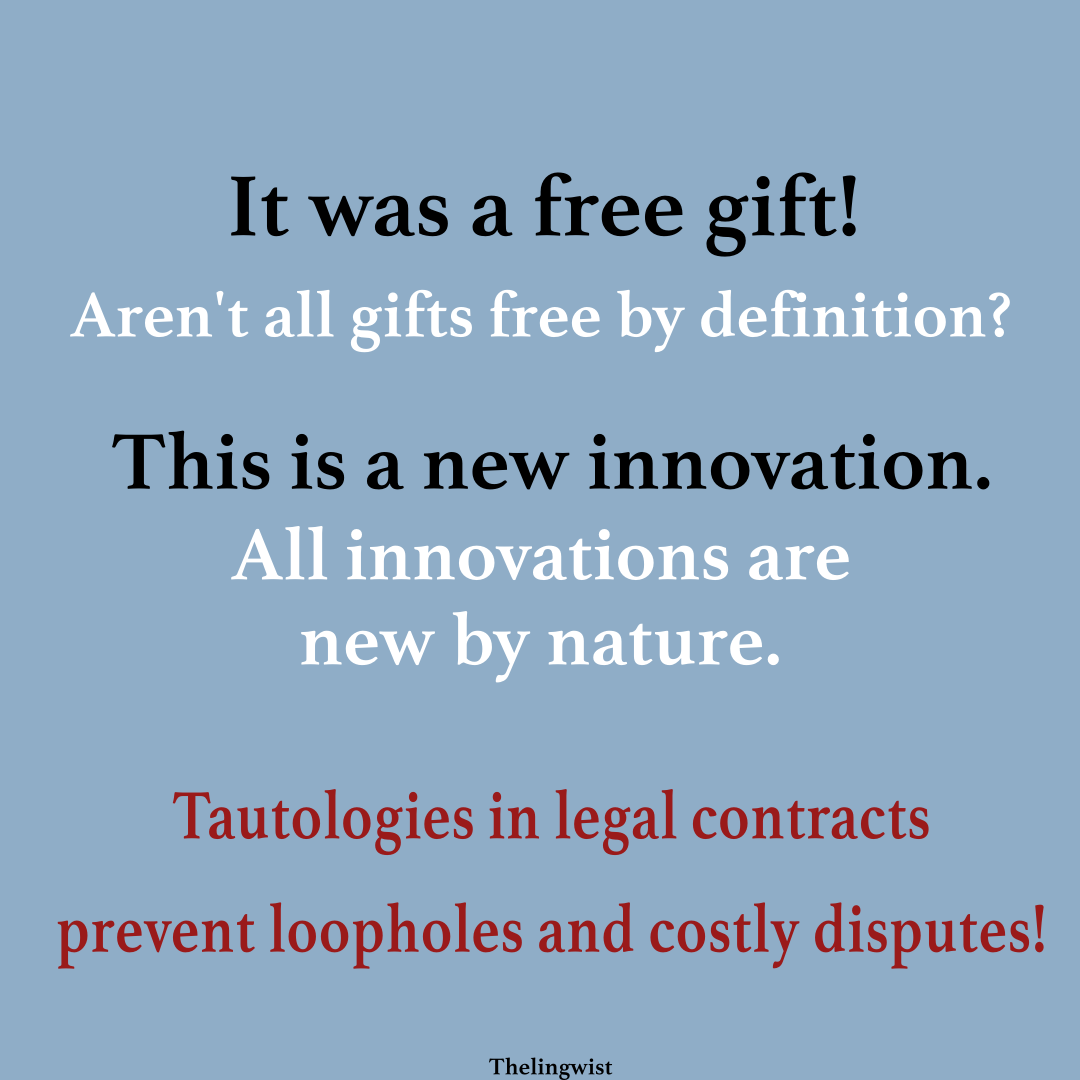
- “Free gift” – A gift is, by definition, free.
- “I saw it with my own eyes” – Seeing something implies the use of one’s eyes.
- “ATM machine” – The “M” in ATM stands for “machine,” so you’re essentially saying “Automated Teller Machine machine.”
- “PIN number” – Similar to ATM, the “N” in PIN already means “number.”
- “True fact” – A fact, by nature, is true.
These phrases pop up all the time in conversation. We use them naturally, even though they’re redundant!
4. Importance of Recognizing Tautology
Recognizing tautology in writing or speech is vital for effective communication. Here’s why:
- Clarity: Avoiding tautology makes your writing clearer and more concise. Too much repetition can confuse the reader or make your point seem less convincing.
- Professionalism: In formal writing, like essays or business documents, tautologies can appear unprofessional or lazy. Clear and concise writing is more respected.
- Focus: When you avoid redundant phrases, your key ideas stand out more. This is especially important in speeches, persuasive writing, and presentations.
5. Is Tautology Always a Bad Thing?
Interestingly, tautology isn’t always a bad thing. In some cases, it can serve a rhetorical purpose. For example, using tautology can create emphasis or clarify meaning, especially when speaking to a broader audience that may need simple repetition to understand the point.
Take for instance, a football coach saying: “We have to win, because winning is what matters.” Though redundant, the repetition emphasizes the significance of winning in that context.
Additionally, in poetry and literature, tautology can be used for dramatic effect or to set a rhythmic tone.
6. How to Avoid Tautology in Writing
To avoid tautology in your writing, follow these simple tips:
- Edit for conciseness: Read your work and ask yourself, “Is this idea being repeated unnecessarily?”
- Use a thesaurus: Instead of repeating the same idea, find synonyms or related concepts to enhance your message.
- Be mindful of common tautologies: Watch out for frequent offenders like “necessary requirement,” “basic fundamentals,” or “past history.”
Famous Tautologies in Literature and Pop Culture Tautology often finds its way into pop culture. A great example comes from the comedian Yogi Berra, who famously said, “It’s déjà vu all over again.” This redundant phrase has since become iconic for its unintentional humor
Even in literature, authors sometimes use tautology for stylistic effect. William Shakespeare used tautology in Hamlet when Polonius says, “Since brevity is the soul of wit… I will be brief.” Though this isn’t strictly a tautology, it’s humorous because the long-winded Polonius isn’t brief at all!
7. Tautology vs. Pleonasm: What’s the Difference?
Tautology and pleonasm are often confused because both involve redundancy. However, pleonasm specifically refers to the use of more words than necessary to express an idea. For example, “I heard it with my own ears” is pleonasm because “with my own ears” is redundant.
Tautology, on the other hand, repeats the same idea in different words, like saying, “He made it with his own hands” (when “made” already implies the use of hands).
Ever Wonder What Happens in the Brain of a Polyglot?: Tautology: Understanding the Art of Redundancy in LanguageSpoonerisms: Hilarious Slip-Ups and Funny Language Flips: Tautology: Understanding the Art of Redundancy in Language1. What is a tautology in simple terms?
A tautology is when the same idea is repeated unnecessarily in different words. For example, “free gift” is a tautology because all gifts are free by definition.
2. Can tautology be used for emphasis?
Yes, in some cases, tautology is used to emphasize an idea or add clarity. Repetition can make a point stand out more strongly.
3. What’s the difference between tautology and pleonasm?
Tautology repeats the same idea in different words, while pleonasm uses more words than necessary. For example, “burning fire” is pleonasm, and “the end result” is tautology.
4. Is tautology a grammar mistake?
Tautology isn’t necessarily a grammar mistake, but it can be seen as a style issue. It often makes writing less concise and professional, so it’s best to avoid it in formal writing.
5. How can I avoid tautology in my writing?
To avoid tautology, revise your writing carefully, remove unnecessary repetition, and use synonyms to keep your text concise and clear.